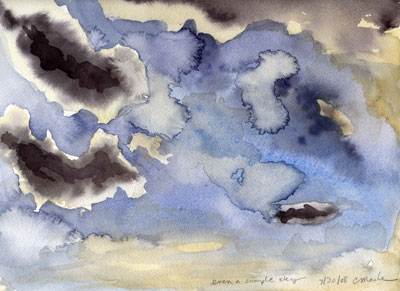
She said see the grass turn down stream,
how the crow assembles out of the shadows
in the eye of a fish at dusk.
She said a bush is always grasping for water
underground. Every movement is many times
and places moving
away, accruing, up the page.
It’s not a riddle but a verb, she said,
washing hourly across the matte,
suspended like a solitary fish.
He said tell why you dropped the dark
into the river and fooled the fish to sleep?
She said you see a fish in the shallows.
I see a blacksmith’s hammer.
Why not say we see a swim bladder. Or a raven fixed
in the fork of that tree as a week’s worth of sleeplessness.
Did we really see a man crushed in a deserted city
deserted, did we really hear a man say that all
would be well as he broke our oars with an ax?
A cat unlocks a green eye, a child finds
a marble in the grass.
The priest opens his palms
to the rain and imagines a million gods
refracted in a healed scar.
The sky slowly slowly
draws us up unwilling
And soon I myself will rise, he said,
bleed across the page,
join you in the stillnesses of water and fish.

He read in places where birds assemble wind and storm
a billion years of light cutting the round of a lime
in two. It has always been true that his symbol is light.
He can be found in shaded spaces under stone, ice,
in the scatter of color in the beds after rain
or the buzz of the wasp trapped in a honey drop.
A child’s word flits like a butterfly at every dawn
not too big but just the right length
to land on a mushroom bulb appearing
on a spot suddenly at the foot of a tree
still warm from the garden lamps. The sun rises
and he sees a bear hunched and paint-spotted
emerge from the village street to mutter and yawn
at the sky. The bear sits, the man sits. Both wonder
at a word drifting, like a feather, from off the green.
It finds rest on the grass between them and purrs.

One day the dictator happened by a window
and saw all the women of the world
seated on his lawn.
The dictator asked would they share tea
by the pond, by the pool, by that body
he had yet to get to given the time,
the demands of the job.
One woman spoke for the others.
She said, yes, they would have tea
(those sugar cookies look wonderful, too)
if he’d agree to eat his foot
on a rocky hill top and if they could please
watch him dine this would fit with the rules of courtesy.
A saw blade appeared out of the crowd like an alligator.
The dictator said he’d rather just have the tea.
The spokesperson said
they’d rather the dictator agree but that
either way they’d have their tea
on a hill top
where the wind becomes a tiger dashing from a story
of crows and the birds can be seen already gathering,
their eclipses racing like shreds
of black paper through the chalky stone.
The dictator heard the call of something idiophonic
and sad brush his ear. He raised an elbow against the birds,
ran out the back, and rushed
into a country
ragged as the growl of a cat.

At the hostess’s party
the women let go—in her absence—
They made the house theirs,
wresting it from its own, other order.
They painted one wall black, took the joists down
from the attic floor with reciprocating saws
so that the dust from storage drifted
onto a carpet retaining the smells
of Afghani men smoking over
changes to forget, the shadows
of children on the walls, how the stones
crack and call in the cold.
The women broke holes in the walls
to watch each other through,
wrote no men allowed with sugar
dispensed from a can
on a picture window that looked
onto the road to work or the passage to places
where the hostess might be waiting,
in the cool floor of the canyon,
in what high shadows where birds
weave their nests.
In a world where bridges will fall
and the Minotaur crouches
with an empty cup in those narrow
spaces between the houses.

There was an old woman who made
Impatiens out of fire, stars from sugar
cubes, and water from the gaiety
of whales. She told me
in a playful moment by the river,
she just went with it,
told me a story about a man
with gum on his sole who stopped,
wrenched up his shoe bottom,
and heard the palms of two friends
meet in an office two years ahead and he
wondered how such a thing could be.
In a gentle dip at the sandy river,
she just went with it.
I could go back in time, she said.
I could go back in twos, she said.
I could assume the sublime
in everything and strip the white
from the prevarication of paper
and find sympathetic greens, saturated reds,
winds feathering out of the blow holes of whales.
I see her eyes in the grass, attending me
like the burn of the running sun
and go with it.

Does the dusk
Do the clouds
Bleed
The rose asked
Its knifes held
Against the open sky

We see wings brush the Milky Way’s back
on a walk across the hill under a moonless
sky and suddenly night turns on us like a stampede,
a crash from all sides we take for danger.
Rhinos from the bushes near the water,
buffalo rushing from underground, armies
on chariots swarming from the East,
and creaking tanks rising like hollow stones
from cracks in the ground we must have missed
in the dark. I fall, fearing the weight of the light.
I feel my love’s hand. I hear a wing snap on a thread
of muscle. My love smiles and points out the bear
and its constant asterism, bleeding from behind
like oil through silk, and I see the negative sky burst
above us. The world hushes. A breeze comes.
The grass scratches our cheeks. The bear drifts
softly, quietly down sky, like a black brush
dipped into water or passed across the wetted page.

She told me she’d seen the stars collide
and collect in a spectral petri dish. She said
it was an image of the future, a vision
that had come after the rains went still
and the birds had rushed out of the East
on a hot gray wind with the voice of two
cracked violins whose notes had ceased
years ago in a hall long gone to wood dust.
I’m old, she said, and you’re much younger,
and you’ll probably believe such a thing,
that I tossed those remnants from my dish
into the sky and what you see when you fall
out of bed and stare high out your window
is fragment, echo, the skin cells of other billions,
like afternoon motes in moving room light,
falling onto water, powdering the leaves,
hardening the throats of frogs. No, he said,
listening. You say you caught the pieces
of broken stars and dashed them into the sky
so that they appear random like motes, concrete
grains in the wind, a billion lives that once
watched, like us, the sky, reading messages,
shapes, the future, and so we meet at a distance,
and our joining is like water mixing life with death.

I just cut the grass
trimmed, scuffled
a bedfull of weeds
how wet everything is
the white roots
the chocolate soil
where worms twist at the sun
when unearthed
and the ground bees have laid
their children
for the year to come
the swarms are now
the best
first of spring
My knees are brown
the sun puddles
on the green
and my hands shake
with minds of their own
and I wonder about bulbs,
seashores, the dryness
of lunar
white on the walls
of the house
at midnight
the sun warms my hand
with a yellow touch
the dark green grass
a bed for us
my hand
the yellow print
the lawn
already reaching
for the bush leaves
nearest the earth
there a rabbit
with a whole eye
there smoke under the clouds
good days for rain
at night
good nights
for moon prints
on the grass

Like the man who thought
every phone might be ringing
for him in Calvino’s
traveler,
I think that the colors
of the world are all
meant for (or trapped in) me.
Rose and carmine and indigo
detonating deep inside. How oil
insinuates into engines, so
lisianthus lubricates the rounds
behind my purpling eyes,
the curves at the joints
when I bend,
stirs the blood that drips
when I crush red
in my hands and scream
with joy the tint
of my tongue.
I am the one you see
asleep in your beds
at sunrise, in the evening,
picking through the amethyst,
lime, and red primrose
and when you shout
for the law I laugh,
leap into the yard
next door, and the dogs,
they bark me on as the day
rolls and the colors
oil and frisk in my veins,
swirl in my fingernails
and the lightning strikes
as I run, mouth contorted
with the embrochure
of sweet, sting, and leaf,
freezing me
white in the field.

He should have told her that light is his symbol.
He should have told her what stones say.
He should have told her he’d carry her books, pack, charms.
He should have told her his real name in the park where the trees grow like statues.
He should have told her how he feared what was underneath.
He should have told her his favorite flower, flavor, fondnesses.
He should have told her how he’d played on the monkey bars.
(He did but he couldn’t say whether she’d heard or understood)
He should have told her why that hurt had dried in the shape of a fish.
He should have told her to add salt to boiling water.
He should have given her a list of jokes, things to bring home from far away.
He should have given her paintings about patience.
He should have assembled the sky out of the zest of black suns.
He should have given her things to refuse, like flowers, chicken farms.
He should have given her attention in crowded rooms.
He should have given her roses, fawns, a kiss in the rain.
He should have given her blood, a knife to strike with, because that’s how wounds are healed.
He should have given her spells.
He should have brightened her mood and her windows.
He should have brightened the cave where waters echo, drip.
He should have lengthened the day, the night, the hours in between.
He should have loosened, tightened, taken off, stuck, adumbrated.
He should have stood by, stood long, even as she went back for something lost.
He should have followed when she strode in the shadows of mountains.
He should have followed her down the hill.
He should have followed her into pools of blood.
He should have counted her footsteps, her breaths when he couldn’t sleep.
He could have could have could have could have
Caught her on the last day of the world.
They could have gone down into the city together.
Where the lights crash the sky.

In a dream I saw umber birds inking
like knife slices out of a rolling lowland.
I hurried to them, approaching on the back
of a seed that had raised me from the valley floor
on a cool wind, an idea, a country emerging
with sails from its cities, engine gears creaking.
But when I reached the place, they had winged
away leaving shadows on a russet ground
that said, “Soon we will return. Or write us.
And remember–at least as long as signals last.”
And last. At least as long as a shadow can stay
in one place. They’re like tiger prints in the blue
snow. See how deep the holes go. And go. Alas,
they never did return. Rather, the wind let me down
on a shore where the grass was silver gray
and spread off above the water to the ankles
of mountains like an impossible number of heron legs.
I waded, made way through the fields. The air
turned thin above the verticals where light
touches the world first, and woke up cold,
sore, high above the writing on a stone under
a green tree striking a pose against storms coming.

He did not lose his son.
His son lost him, embellishing
a face at other doors and windows,
other elaborations shaped
like moons or buttons watching
him pass through sun, rain,
and evening mist, a gray hand
reaching from a door, like a wish.
And:
The stone had an idea about phases
How one can go from green
To gray against yesterday’s
And tomorrow’s sky. In between,
We are, he said. Then we’re not,
As the leaf, with a drop of the river
On its stem, turned under a limb
Slowly and passed into days to come.

A man had an encounter with a stone.
He told the stone a story.
But the stone wasn’t a fan of riddles.
So he broke the man’s foot.
Then he broke the man’s head.
Then he buried the man in a garden.
It’s a good story, the stone said.
About gardening, the man said.

We are made of light aspiring
outward like the edge of night and day
whose interstice is not the line but a circle
you can carry and swing in your hand.
Let the bear pass through.
Like the death of things,
the crow will disassemble into plurals
and pass mostly quiet through the grass.
and
He still remembers the moment
his son was born. How a moon
hot as the sun came out of her
on a bed with the sheets kicked off,
strong slick fingers out-held.
See the green reeds chase the rushing
crow. See him raise the child
to the light, where the moon rides.


